Subscribe by Email

Your email:

Follow the dentists and their dental thoughts on:

facebook dentist link

link to twitter dentist page

link to youtube dentist page

Dentistry in the News

Submit a link

Salt Lake City Dentist Blog

Current Articles | RSS Feed RSS Feed

Is Hollywood Giving Dentists a Bad Rap? Sedation Dentists Aim to Change That

  | Share on Twitter Twitter | Share on Facebook Facebook | Submit to Digg digg it |  Add to delicious  delicious |  Submit to StumbleUpon StumbleUpon | Submit to Reddit reddit 

Sadist Dentist resized 600With Hollywood’s perception of dental professionals it is easy to be fearful of going to the dentist.  The famous Bill Cosby skit about a painful visit to the dentist or movies such as “The Dentist” or “Ghost Town”, are what some patients think of when coming to an appointment. Even the upcoming T.V. show Glee will have a new character that is portraying a dentist. With some of the bad publicity dentists’ get We’d like to a shine light on the reality of a dental visit at Legacy Dental. Below are just some of the many ways we keep our patients anxiety free for dental procedures.

Oral Sedation: Anxiety and fear are easily overcome with safe and effective oral sedation. The prescription is taken before or at the beginning of you appointment. 

IV Sedation: IV sedation is done by certified dental anesthesiologists.

Quieter Electric Handpiece (Drill): Gone is the loud whine of the drill. Plus greater accuracy and shorter procedure time are additional advantages of latest technology from Germany.

Diagnodent Laser: This laser is used for accurate early cavity detection.

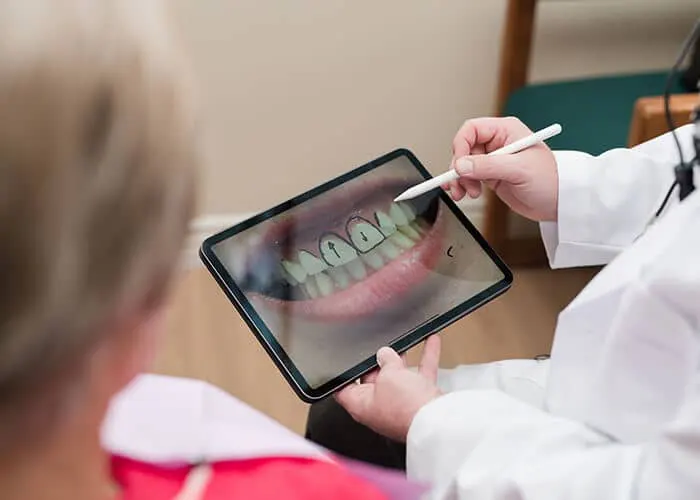
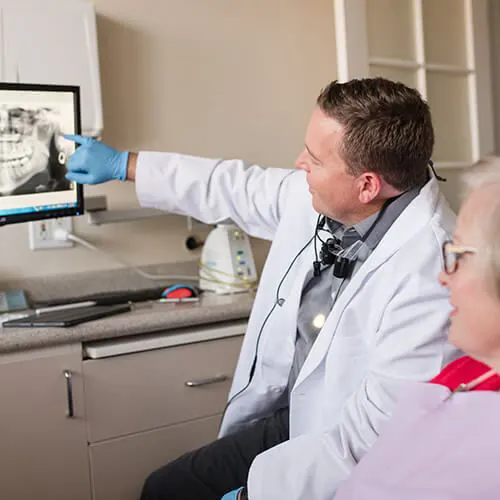
Intraoral Camera: A small camera that lets both patient and doctor see better. Seeing what the dentist sees gives our patients more information about their mouths. More information makes for better treatment decisions.

The Wand for more comfortable local anesthetic: The most comfortable local anesthetic ever. The WAND has replaced the traditional syringe. Computerized, it delivers the anesthetic in the most gentle way, making the experience imperceptible by most patients.

Nitrous Oxide (Laughing Gas): Nitrous Oxide is a gas that is breathed which will help a person feel more relaxed during the dental procedure. It can be given without any after effects and is given at no extra cost in our dental practice.

TV, Movie, or Music during procedure: Through the technology of Apple TV one can listen to music or watch T.V. or Movie while their procedure is being done.

CariFree: We can actually help you to be much less likely to ever get another cavity. First we test your mouth for the cavity-causing infection. If present, we treat the infection with antibiotics used in a combination of mouth-rinses and toothpastes.

=---=

Article written by Katie Poulsen, RDH, BS. Katie is a dental hygienist at Legacy Dental in Salt Lake City, Utah.


Fluoride at Your Dentist Appointment. Is it Just for Kids?

  | Share on Twitter Twitter | Share on Facebook Facebook | Submit to Digg digg it |  Add to delicious  delicious |  Submit to StumbleUpon StumbleUpon | Submit to Reddit reddit 

Fluoride has long been a part of children's dental appointments, but did you know that the latest research suggests that it offers many benefits to adults as well?

Fluoride makes your teeth stronger. This makes them more resistant to cavities, less sensitive, and can even reverse or heal cavities that are just getting started. Fluoride also makes bacteria produce less acid. Regular applications of fluoride have shown to reduce the risk of getting a cavity by as much as 75% and can reduce sensitivity for up to 6 months.

The best way to apply fluoride is with a varnish at the dentist. Fluoride varnish is a pleasant tasting material that is painted on your teeth. It sets in seconds and there are no eating or drinking restrictions, but you are advised to wait to brush for 4 hours. Everyone can benefit from fluoride application, but adults that are at moderate risk should have fluoride applied every 6 months.

------

This article was written by Cori Skiby, RDH. Mrs. Skiby is a dental hygienist at Legacy Dental, in Salt Lake City, Utah.

Did the Dentist Tell You to Brush & Floss and You Still Got Cavities?

  | Share on Twitter Twitter | Share on Facebook Facebook | Submit to Digg digg it |  Add to delicious  delicious |  Submit to StumbleUpon StumbleUpon | Submit to Reddit reddit 

"But I brush and floss every day." 

I hear it almost every day when I have to tell a patient that they have a cavity. We both feel bad. My patient feels like there's nothing they can really do to prevent cavities. I, their dentist, feels like I'm giving them bad news or news they weren't expecting.

So what's happening and can we do anything to stop it?

Cavities are formed when the pH (acidty) on the tooth is less than 5.5. The lower the pH number the more acidic. There are many foods and drinks that are acidic. Soda pop, fruit juices, and sports drinks, even the diets ones are very acidic. But more damaging is the acid caused by the bacteria that may live in your mouth. There are thousands of them. What we are learning is that people that get cavities despite their best efforts oftentimes have more of these acid-producing bacteria than other people. An interesting thing about these acid-producing bacteria is that they thrive and increase in numbers the more acidic the environment.

Some might say, "Just clean them off with brushing and flossing." The problem is that within minutes the bacteria are back on the teeth. Brushing and flossing for some is not enough.

So what can be done? The first thing is to find out if you have the infection that causes cavities. This is done by rubbing a swab on your lower teeth and placing it into a special meter. If theCavity Meter test indicates that you have the infection, then the infection should be treated. The infection can be treated with a combination of very specific mouthrinses, sprays, gums, and toothpastes used for a specific length and amount of time. After 3 months, another test is performed to see if the infection is still present. If the infection is cured, then a preventive regimen is continued.

Early results show that people that seemed to get cavities at every check-up now are finally cavity free. Now that's something to smile about!

----------------

The dentists at Legacy Dental, in Salt Lake City can perform this test and help you to treat the cavity infection you have. For a limited time we will perform the test for only $5. 


Dental Sealants, A Dentist's Tool for Preventing Cavities

  | Share on Twitter Twitter | Share on Facebook Facebook | Submit to Digg digg it |  Add to delicious  delicious |  Submit to StumbleUpon StumbleUpon | Submit to Reddit reddit 

The grooves on teeth are often smaller than a single tooth brush bristle. Because the grooves are so small they can't be effectively kept clean and are a common place for people to develop cavities. A dental sealant is a resin (a special type of plastic) that is applied over these grooves. The dental sealant prevents food and bacteria from entering these grooves. Preventing food and bacteria from entering these grooves prevents cavities from forming. A dental sealant done well has historically been an excellent way to decrease the risk of having cavities. It does not do anything to decrease the risk of cavities from forgetting to floss.

Sealants are so effective in preventing cavities that many times they are offered at schools to children unable to see a dentist. Oftentimes these sealants are placed by dental students, or dental hygiene students, or others with less training than a dentist. There has been some concern that sealants placed by inexperienced individuals in a less than ideal setting (at school) may not lower the child's risk for cavities and may even increase their risk.

In November of 2009, the Journal of the American Dental Association published the findings  of Barbara F. Gooch, DMD and others in their article "Preventing Dental Caries Through School-Based Sealant Programs."

Beginning in 2005 they looked at the dental sealants ability to help prevent cavities. In looking at 10 different studies, they found that on average cavities were reduced by 59% after more than 4 years. That's great news and supports what we had assumed. You will decrease the odds of getting a cavity in a tooth by 60% if the tooth is sealed.

But what if the sealant is not placed well? Does that increase the risk of getting a cavity? They found in looking at seven studies that teeth where a sealant was placed but then lost or partially lost were at same risk to get cavities as if a sealant were never placed. So having a sealant, even a bad one, does not increase your rate to get cavities.

So what's the takeaway message. Children's teeth should be sealed to decrease their risk for cavities and this can be done successfully in a school-based program.

Most insurance companies cover sealants on back teeth up to a certain age. There is less evidence to support the use of dental sealants in adults. However, those adults that are at high risk for cavities should probably have their molars sealed as well.

 

All Posts